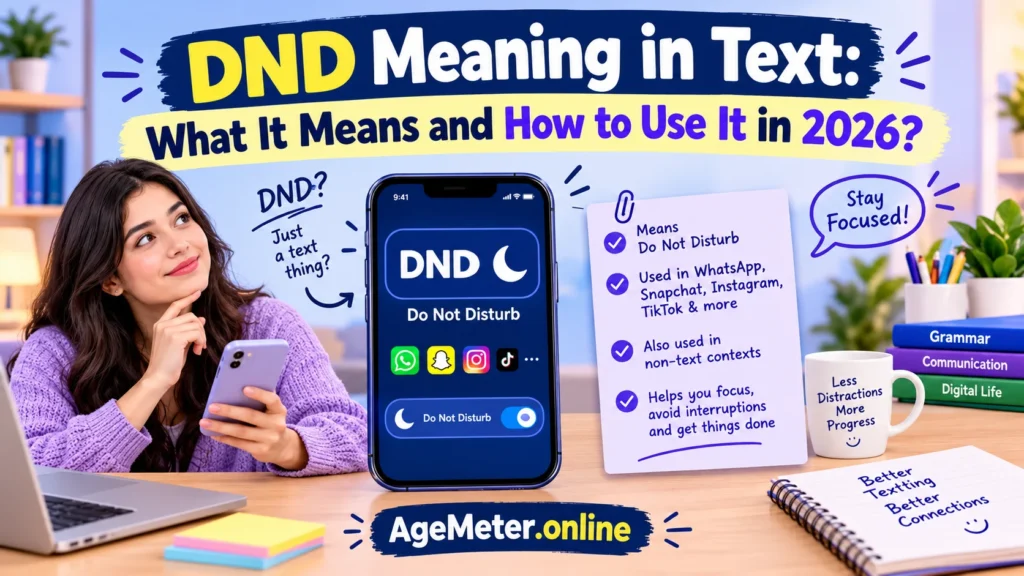
DND Meaning in Text refers to “Do Not Disturb,” a common abbreviation used in text messages, social media chats, and everyday online conversations. When someone says “I’m on DND,” they usually mean they want fewer interruptions or need some time to focus.
People use DND when they’re studying, working, resting, or taking a break from notifications. However, the exact meaning can depend on the conversation. In some contexts, DND describes a phone setting that silences alerts, while in others, it simply tells people that someone isn’t available to chat.
In this guide, you’ll discover what DND means in text, how people use it on social media, and how it works on different phones. You’ll also find real chat examples, learn the difference between DND and similar terms, and discover how to respond naturally when someone sends you this abbreviation.
If You Calculate Your Age Then Visit this link:https://agemeter.online/
DND Meaning in Text
In texting, DND stands for “Do Not Disturb.” It tells someone that a person wants to avoid interruptions or is temporarily unavailable.
For example, your friend might text, “I’m on DND tonight. I’ll reply tomorrow.” This usually means they want some uninterrupted time rather than an ongoing conversation.
People commonly use DND when they’re:
- Studying for an exam or finishing work.
- Sleeping, resting, or taking a break.
- Attending a meeting or important event.
- Playing a game or watching a movie.
- Taking time away from messages and notifications.
DND can describe an actual phone setting or simply communicate a personal boundary. The surrounding words help you understand which meaning applies.
What Does DND Mean in Different Contexts?
Although “Do Not Disturb” is the most common meaning in digital conversations, people use it in different situations.
DND Meaning in Casual Text Messages
Friends and family often use DND to explain why they aren’t available to chat.
Example:
Alex: Want to talk on the phone?
Jordan: Not tonight. I’m on DND and catching up on sleep.
Here, Jordan is letting Alex know that they don’t want interruptions. It doesn’t necessarily mean they’re upset or avoiding Alex personally.
DND Meaning on Snapchat and Instagram
On social media, DND can refer to notification settings or a person’s desire to avoid incoming alerts.
For example, someone might post, “DND mode all weekend,” to explain that they’re taking a break from notifications.
However, DND doesn’t have exactly the same meaning or features across every platform. Check the app’s settings to understand what its specific controls do.
DND Meaning in Professional Communication
At work, DND usually signals that someone needs uninterrupted time for a task, meeting, or deadline.
For example:
“I’m on DND until 2 p.m. Please email anything urgent.”
This message communicates availability and gives coworkers a clear expectation. In professional settings, adding an end time or alternative contact method makes DND more useful.
DND Meaning in Gaming and Online Chats
Gamers may use DND to indicate that they don’t want interruptions while playing a match, streaming, or concentrating on a game.
For example, “DND until this match ends” means the player wants to focus on the current game.
In gaming communities, DND can also refer to Dungeons & Dragons, the tabletop role-playing game. The conversation usually makes the intended meaning clear.
What Does DND Mean on a Phone?
On a phone, Do Not Disturb is a feature that limits interruptions from calls, alerts, and app notifications. It lets you focus without having to turn off your device.
Apple provides Do Not Disturb through its Focus features. Android also offers Do Not Disturb controls that let users manage which notifications can interrupt them.
Official guides explain how to configure these options:
- Apple Support: Set up a Focus on iPhone
- Google Android Help: Limit interruptions with Do Not Disturb
Does DND Block Calls and Text Messages?
Usually, no. Do Not Disturb generally controls notifications rather than blocking communication entirely.
Depending on your settings, your phone may receive a text message without playing a sound or showing a normal interruption. Calls may also be silenced unless you allow particular contacts or repeated callers.
Here’s the important distinction:
- Message delivery: DND doesn’t generally prevent a text from reaching your phone.
- Notifications: DND can silence or filter alerts.
- Allowed contacts: Certain people may still reach you if you’ve configured exceptions.
- Emergency situations: Some devices and settings provide exceptions for specific critical alerts.
Don’t assume every device behaves identically. Manufacturer settings and operating system versions can change the details.
Can Other People See When You Have DND Turned On?
Sometimes. For example, an iPhone user can share a Focus status that tells others their notifications are silenced. This depends on the user’s settings and the app involved.
On other devices or platforms, DND status may remain private. Turning it on doesn’t automatically notify everyone in your contact list.
Real Chat Examples of DND in Text
The easiest way to understand DND is to see how it works in everyday conversations.
When Someone Is Studying
Mia: Why aren’t you replying?
Sam: I’m on DND until I finish studying. I’ll text you later.
Meaning: Sam wants to concentrate and plans to reply afterward.
When Someone Needs Rest
Chris: Are you coming online tonight?
Taylor: Probably not. DND mode until tomorrow 😴
Meaning: Taylor wants some quiet time or sleep.
At Work
Manager: Can you join a quick call?
Employee: I’m in a focused work session until noon. Please message me if it’s urgent.
Meaning: The employee is protecting their work time and explaining when they’re available.
While Gaming
Player 1: Join our next match?
Player 2: DND until I finish this round.
Meaning: The player doesn’t want interruptions during the current game.
These examples show that DND usually communicates temporary unavailability. It doesn’t automatically reveal someone’s feelings toward the person messaging them.
How to Respond When Someone Says DND
When someone tells you they’re on DND, the best response is usually simple and respectful. You don’t need to keep asking why they’re unavailable.
Simple and Respectful Replies
Try these natural responses:
- “No problem! Talk later.”
- “Sure, message me when you’re free.”
- “Got it. Enjoy your break!”
- “All good. I’ll let you focus.”
Professional Replies
If a coworker or manager says they’re on DND, acknowledge their availability and use another communication method if appropriate.
Examples:
- “Understood. I’ll send the details by email.”
- “No problem. Let me know when you’re available.”
- “I’ll follow up after your focus time.”
What If Your Message Is Urgent?
Explain the urgency clearly and use an appropriate alternative contact method if necessary.
For example: “I know you’re on DND, but the meeting has moved to 10 a.m. Please check the updated schedule when possible.”
Save urgent interruptions for genuinely important matters. Respecting someone’s time helps maintain healthy communication.
DND vs. Silent Mode, Airplane Mode, Blocking, and Muting
These terms may seem similar, but each describes a different function.
| Feature | What it means | Does it usually stop message delivery? |
| DND | Limits interruptions from notifications and calls | No |
| Silent mode | Mutes sounds from calls and notifications | No |
| Airplane mode | Disables cellular connections and other wireless functions as configured | Cellular delivery may be delayed while disconnected |
| Block | Restricts contact from a specific number or account | It depends on the service |
| Mute chat | Stops or reduces notifications from a particular conversation | No |
For example, if you mute a WhatsApp chat, messages can still arrive without your phone notifying you normally. If you enable DND, your phone may silence notifications from several apps at once.
Remember: DND and silent mode don’t necessarily hide notifications in the same way. Their behavior depends on your device and settings.
Other Meanings of DND
Although “Do Not Disturb” is the most common interpretation in texting, DND can mean something else in a specific context.
DND Meaning in Dungeons & Dragons
In gaming conversations, DND can refer to Dungeons & Dragons, a tabletop role-playing game in which players create characters and participate in adventures guided by a Dungeon Master.
For example:
“We’re playing DND this Saturday. Want to join our campaign?”
Here, the abbreviation refers to the game, not a phone setting.
DND in Specialized Settings
Organizations may use DND as an internal abbreviation for a department, process, or service. However, those meanings aren’t universal.
If you encounter DND in a specialized document, check the surrounding topic or ask the sender what it means.
Common Misunderstandings About DND
Several misconceptions can cause unnecessary confusion.
DND Doesn’t Automatically Mean Someone Is Ignoring You
A person might be working, sleeping, studying, or simply taking a break from notifications. You can’t determine their feelings from three letters alone.
DND Usually Doesn’t Prevent Messages From Arriving
On most phones, DND manages interruptions rather than blocking incoming texts. The recipient may see your message later.
DND Isn’t the Same as Airplane Mode
DND generally limits notifications. Airplane mode disables cellular connectivity and may affect other wireless connections depending on the device and settings.
DND Doesn’t Mean the Same Thing Everywhere
Context matters. Someone discussing phone settings probably means Do Not Disturb. A gaming group discussing its next campaign might mean Dungeons & Dragons.
How to Tell What Someone Means by DND
If you’re unsure, use these simple clues to interpret the message correctly.
- Read the full sentence: “I’m on DND until tomorrow” probably refers to temporary unavailability.
- Check the conversation topic: A discussion about notifications points toward phone settings.
- Consider the platform: App-specific features may use their own controls and labels.
- Ask politely: “Do you mean you’ve turned on Do Not Disturb?”
Avoid jumping to conclusions. A short message rarely tells the whole story.
FAQs
Q1 .What does DND stand for in texting?
DND usually stands for “Do Not Disturb.” People use it to communicate that they want fewer interruptions or aren’t available to chat.
Q2. What does “I’m on DND” mean?
It usually means the person has enabled Do Not Disturb on their device or wants others to know they’re unavailable for a while.
Q3. Does DND block calls and text messages?
Not usually. DND generally silences or filters notifications while allowing messages to arrive. Specific call behavior depends on the device and settings.
Q4. What does DND mean on Snapchat or Instagram?
It may refer to Do Not Disturb settings or a person’s desire to avoid notifications. The exact meaning depends on the context and the platform’s features.
Q5. Is DND the same as silent mode?
No. Silent mode primarily mutes sounds, while DND can manage which calls and notifications interrupt you.
Q6. Does DND mean someone doesn’t want to talk to me?
Not necessarily. They may need time to work, rest, or focus. The abbreviation alone doesn’t prove that they’re avoiding you.
Q7. Can DND mean Dungeons & Dragons?
Yes. In gaming conversations, DND can refer to Dungeons & Dragons, a tabletop role-playing game. The context helps distinguish it from Do Not Disturb.
Conclusion
DND usually means “Do Not Disturb” in text messages and online conversations. People use it to explain that they’re busy, need uninterrupted time, or want to limit notifications.
On phones, DND typically silences or filters alerts rather than blocking messages. In gaming conversations, it can also refer to Dungeons & Dragons.
When someone texts you “DND,” look at the context before assuming what they mean. A simple, respectful reply is often all you need.