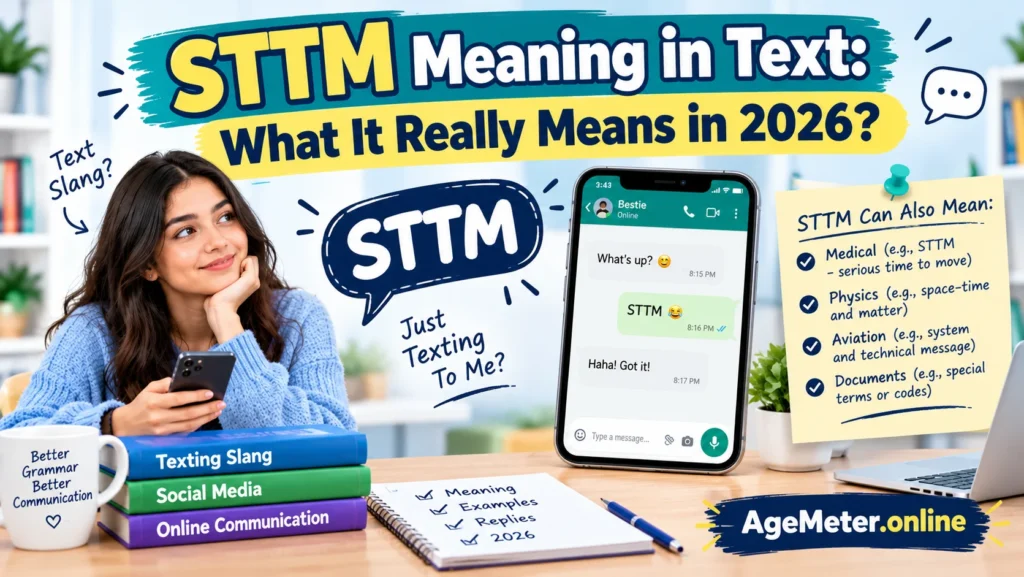
STTM Meaning in Text usually refers to “Stop Talking To Me,” a phrase people use when they want to end a conversation or ask someone for space. However, the exact meaning can change depending on the conversation and the sender’s intention.
Unlike popular texting abbreviations such as LOL (Laughing Out Loud) and BRB (Be Right Back), STTM isn’t universally understood. Some online slang references also list “Send This To Me” as an alternative meaning, especially when people discuss sharing photos, videos, or links.
So, how can you tell what someone really means? Pay attention to the conversation, tone, and relationship you share with the sender. A friend might use STTM jokingly after an embarrassing comment, while someone else might use it to express genuine frustration or request personal space.
If You Calculate Your Age Then Visit this link:https://agemeter.online/
What Does STTM Mean in Text?
The most relevant meaning of STTM in texting is “Stop Talking To Me.” It shortens a direct request into four letters, making it quick to type during an informal conversation.
People may use STTM when they feel annoyed, want a discussion to end, or need some personal space. Close friends might also use it dramatically as a joke.
Consider this example:
Friend A: “I’m sending that embarrassing picture to everyone 😂”
Friend B: “STTM 😭”
Here, Friend B may be pretending to feel embarrassed rather than seriously demanding silence. The friendship and playful context help explain the message.
However, if someone sends “STTM. I don’t want to discuss this anymore,” the wording suggests a serious request to end the conversation.
The key takeaway: Don’t judge STTM by the letters alone. Read the surrounding messages before deciding what the sender means.
How People Use STTM in Text Messages
STTM can communicate different emotions depending on the situation. Understanding those differences helps you avoid unnecessary misunderstandings.
STTM as a Joke Between Friends
Friends sometimes exaggerate their reactions to teasing, embarrassing photos, or funny comments. In these situations, STTM can express mock annoyance rather than genuine anger.
For example:
“You really told them that story? STTM 😂”
The laughing emoji supports a playful interpretation, although it doesn’t guarantee that the sender is joking.
STTM When Someone Is Annoyed
During a disagreement, STTM may communicate frustration or a desire to stop arguing. The sender might feel that the conversation has become repetitive or uncomfortable.
For example:
“I’ve explained my side already. STTM.”
This message sounds more serious because the sender explicitly indicates that they want the discussion to end.
STTM as a Personal Boundary
Sometimes people use STTM to ask another person to stop contacting them. When that happens, treat the request seriously rather than assuming the sender is being dramatic.
If someone wants space, give them space. You don’t need to agree with their feelings to respect their decision.
STTM Examples in Realistic Conversations
These illustrative examples show how the same abbreviation can carry different meanings.
| Situation | Example message | Likely interpretation |
| Friendly teasing | “STTM 😂 you’re embarrassing me!” | Playful annoyance |
| Argument | “STTM. I’m done discussing this.” | Genuine frustration |
| Uncomfortable conversation | “Please stop. STTM.” | Request to end communication |
| Unclear message | “STTM” | More context is needed |
Case Study: A Joke or a Serious Request?
Imagine that Alex keeps teasing Jordan about a funny mistake. Jordan replies, “STTM 😂.” Because the conversation is lighthearted, Alex might reasonably interpret the message as playful.
Now imagine that Jordan previously asked Alex to stop bringing up a sensitive subject. Alex continues, and Jordan replies, “STTM. I’m serious.”
The abbreviation hasn’t changed, but the context has. In the second situation, Jordan has clearly asked Alex to stop.
This illustrates an important rule: context can help you interpret tone, but a direct request to stop should never be dismissed as a joke.
Other Possible Meanings of STTM
Although “Stop Talking To Me” is a recognized texting interpretation, STTM isn’t a universally standardized abbreviation. Some online references list alternative expansions, including “Send This To Me.”
| Possible meaning | Context | What it communicates |
| Stop Talking To Me | Casual conversation or disagreement | A request to stop talking |
| Send This To Me | Conversation about a photo, video, or link | A request to share something |
| Other specialized meanings | Technical, organizational, or niche communities | Depends on the field and source |
Treat these alternatives carefully. Their inclusion in online lists doesn’t prove that they’re equally common or widely understood.
For example, if someone shares a funny video and writes “STTM,” they might be asking you to send it. However, because the abbreviation is ambiguous, a quick clarification may be necessary.
There’s also no need to assume that every technical document uses the texting meaning. Acronyms can have separate definitions in specialized fields, so consult the relevant document or terminology guide when appropriate.
How to Tell What STTM Means From Context
When you encounter STTM, look at three clues before interpreting the message.
- The conversation topic: Is someone joking, arguing, sharing content, or asking for help?
- The relationship: Close friends may use dramatic language that would sound harsh between strangers.
- The surrounding words: Phrases such as “I’m serious” or “I don’t want to discuss this” make the intended message clearer.
Emojis and punctuation can provide additional clues. For example, “STTM 😂” may sound playful, while “STTM.” after a heated argument may feel more direct.
Still, punctuation isn’t a reliable way to determine someone’s emotions. People have different texting habits, and short messages often lack the tone of spoken conversation.
If you can’t tell what the sender means, ask politely: “Do you mean that jokingly, or would you like me to stop messaging?”
How to Respond When Someone Texts STTM
The best response depends on the situation. Your goal should be to understand the message without escalating the conversation.
Responses to Playful STTM
If you’re confident that your friend is joking, you can keep your reply lighthearted.
- “Okay, okay 😂”
- “I’ll stop teasing you!”
- “Fine, I’ll behave 😅”
Use these responses only when the surrounding conversation supports a playful interpretation.
Responses to Serious STTM
If someone genuinely wants the conversation to end, acknowledge their request and avoid continuing the argument.
- “Okay, I’ll give you some space.”
- “Understood. I won’t keep messaging you.”
- “I hear you. I’ll stop here.”
You don’t need to send a long explanation. A short, respectful response is often enough.
Should You Ask What STTM Means?
Yes, if the context doesn’t make the meaning clear and clarification is appropriate. You could ask, “What do you mean by STTM here?”
However, if someone has clearly asked you to stop contacting them, don’t use clarification as an excuse to keep messaging. Respect the request.
STTM vs. Similar Texting Abbreviations
STTM can be confused with other short forms, especially when readers aren’t familiar with online slang. These comparisons help distinguish their meanings.
| Term | Meaning or function | Difference from STTM |
| STTM | Often “Stop Talking To Me” | May signal a desire to end a conversation |
| STM | Has several possible meanings depending on context | Not automatically interchangeable with STTM |
| STT2M | Not a universally standardized equivalent | Requires context or clarification |
| DM me | Send me a direct message | Invites private communication |
| Leave me alone | A direct request for space | Uses plain language rather than an acronym |
The distinction matters because similar-looking abbreviations don’t necessarily mean the same thing. If you’re unsure, use the surrounding conversation rather than guessing from the letters.
Is STTM Appropriate in Professional Messages?
Generally, avoid using STTM in formal emails, workplace communication, or important discussions. Readers may misunderstand the abbreviation, and its possible meaning can sound blunt.
Instead, choose a phrase that clearly communicates your intention.
| Your intention | Clearer professional wording |
| End a discussion for now | “I’d prefer to continue this discussion later.” |
| Ask for some space | “I need some time before we discuss this further.” |
| Stop receiving messages about a topic | “Please don’t message me about this topic again.” |
Clear language reduces confusion and helps you maintain a respectful tone, especially when discussing sensitive issues.
FAQs
Q1. What Does STTM Mean in Text?
STTM can mean “Stop Talking To Me” in casual texting. Some sources also list alternative interpretations, so the surrounding conversation matters.
Q2. Does STTM Always Mean Stop Talking To Me?
No. Although “Stop Talking To Me” is a recognized interpretation, other meanings may appear in particular conversations or communities. Check the context before assuming.
Q3. Can STTM Be Used Jokingly?
Yes. Friends may use STTM to react dramatically to teasing or embarrassing comments. However, don’t assume it’s a joke when someone clearly asks you to stop.
Q4. Is STTM Rude?
It can sound blunt or dismissive when used seriously. Its tone depends on the relationship, situation, and wording.
Q5. What Should I Reply When Someone Says STTM?
If the message seems playful, a lighthearted reply may work. If the person genuinely wants space, acknowledge the request and stop messaging.
Q6. Should I Use STTM in Formal Emails?
It’s better to avoid it. Write your meaning in full so readers can understand your message without guessing.
Conclusion
STTM meaning in text most commonly points to “Stop Talking To Me,” but alternative interpretations exist. The conversation, relationship, and surrounding words help you understand what the sender intends.
If a friend uses STTM after a joke, the message may be playful. If someone uses it during an argument or asks you to stop contacting them, take the request seriously.
When the meaning isn’t clear, ask politely if clarification is appropriate. A few extra words can prevent a misunderstanding and keep a conversation respectful.