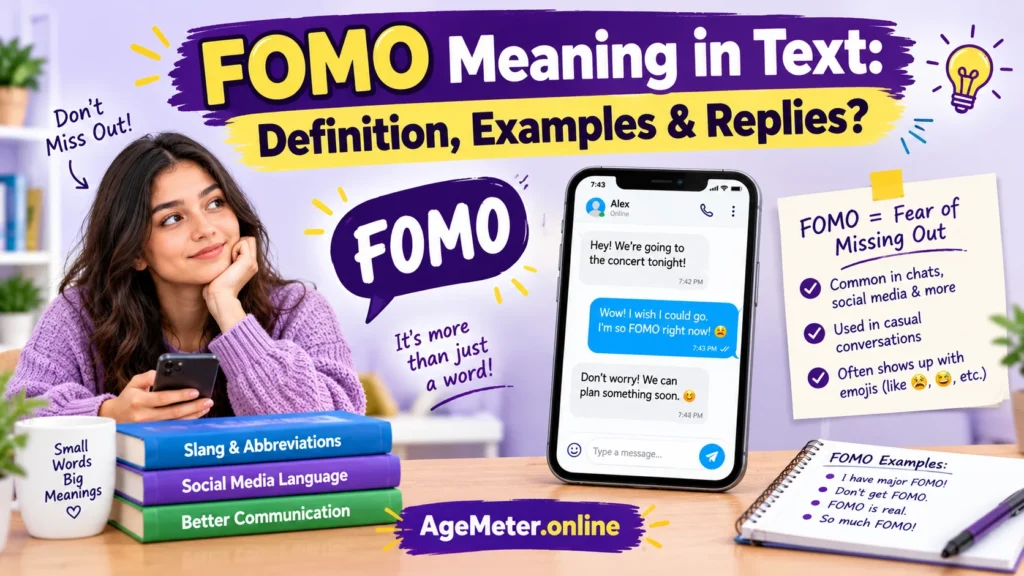
FOMO Meaning in Text refers to the feeling of missing out on something exciting while others are having fun. You might see this abbreviation in text messages, social media comments, or group chats when someone feels left out or wishes they could join an event.
Have you ever seen your friends posting party pictures while you’re sitting at home? That familiar feeling of wishing you were there has a name: FOMO (Fear of Missing Out). People often use this popular abbreviation to express disappointment, curiosity, or playful envy.
Understanding the FOMO meaning in text helps you recognize what someone wants to express. They might feel left out, regret missing an event, or simply joke about an exciting experience. The meaning depends on the conversation, so understanding the context helps you respond naturally.
If You Calculate Your Age Then Visit this link:https://agemeter.online/
What Does FOMO Mean in Text?
FOMO stands for “Fear of Missing Out.” It describes the uneasy feeling that other people are enjoying an exciting experience, opportunity, or event that you’re missing.
In texting, people use FOMO to express this feeling quickly without explaining the whole situation. The abbreviation can communicate genuine disappointment, playful envy, or lighthearted excitement about something they wish they could experience.
For example, imagine your friends go to a concert while you stay home. When you see their photos, you might text, “I’m getting serious FOMO right now!”
The meaning depends on the conversation. Sometimes FOMO reflects genuine anxiety about being excluded. In other situations, it’s simply a casual expression.
FOMO Meaning in Simple Words
In simple terms, FOMO means worrying that you’re missing something fun or important while others get to enjoy it.
Common situations include:
- Missing a party or friends’ gathering.
- Watching someone travel to a destination you want to visit.
- Seeing friends enjoy a concert you couldn’t attend.
- Missing a popular trend everyone discusses.
- Worrying that you might miss an exciting opportunity.
What Is the Full Form of FOMO?
| Abbreviation | Full form | Meaning |
| FOMO | Fear of Missing Out | Worry about missing an experience or opportunity |
| JOMO | Joy of Missing Out | Enjoying your decision to skip something |
| FOBO | Fear of Better Options | Hesitating because another choice might be better |
FOMO is commonly pronounced “foh-moh.” Although people often use it online, the term also appears in dictionaries and psychological research.
How Is FOMO Used in Text Messages?
FOMO can fit naturally into different conversations. The situation usually tells you whether someone feels disappointed, left out, or amused.
FOMO in Casual Conversations
Friends often use FOMO when discussing plans, celebrations, or activities they couldn’t attend.
Example:
Alex: We’re going bowling tonight!
Sam: I can’t make it. Already getting FOMO 😭
Here, Sam wishes they could join the group. The crying emoji adds a playful sense of disappointment rather than necessarily indicating serious distress.
FOMO in Group Chats
Group chats can trigger FOMO when people discuss plans or experiences that others missed. Someone might use the term to express disappointment about being absent.
Example:
Mia: Last night’s dinner was amazing!
Jake: Why didn’t anyone tell me? Major FOMO 😂
Jake might genuinely wish he’d been invited, or he might simply be teasing his friends.
However, FOMO doesn’t automatically mean someone deliberately excluded another person. Plans can happen spontaneously, and people sometimes misunderstand what they see online.
FOMO on Instagram, TikTok, and Other Social Platforms
Social media makes it easy to see other people’s activities throughout the day. Travel videos, concert clips, restaurant reviews, and group photos can all trigger FOMO.
People may comment:
- “This video is giving me FOMO!”
- “Everyone’s at the festival except me 😭”
- “Vacation FOMO is real.”
- “Now I have FOMO about trying that restaurant.”
The definition stays the same across Instagram, TikTok, Snapchat, WhatsApp, X, Discord, and Reddit. The platform changes the context, not the core meaning.
FOMO as a Joke or Exaggeration
Not every use of FOMO describes deep anxiety. People often use it humorously to express a small desire.
For example, someone might write, “I have FOMO because everyone ordered pizza except me.” They probably aren’t experiencing serious emotional distress. They’re just expressing a little regret.
Examples of FOMO in Text and Chat
These examples show how FOMO works in everyday messages.
| Text message | What it means |
| “Wish I could come. FOMO is real!” | The person wishes they could attend. |
| “Those concert pictures gave me FOMO.” | Seeing the pictures made them regret missing the show. |
| “Don’t let FOMO make you buy it.” | Don’t purchase something just because others have it. |
| “Everyone’s trying that new café. FOMO!” | They want to experience the popular café. |
| “I’m staying home tonight. No FOMO here.” | They’re comfortable missing the event. |
| “Sale ends in ten minutes. FOMO is kicking in.” | They’re worried about missing a deal. |
Notice how FOMO can refer to social activities, purchases, or opportunities. Its central idea remains the same: worrying about what you might miss.
How to Reply When Someone Says FOMO
The best response depends on your relationship with the person and the conversation’s tone. A friendly reply might reassure them, while a humorous response can keep things light.
Friendly Replies to FOMO
Use these when someone wishes they could join you:
- “Next time, you’re coming with us!”
- “We missed having you there.”
- “Let’s plan something together soon.”
- “You’ll have to join us next time!”
Funny Replies to FOMO
If you’re chatting with close friends, a playful response might work better:
- “FOMO detected 😂”
- “Your invitation to the next adventure is pending!”
- “You should’ve been there!”
- “The fun was real, not gonna lie 😂”
Choose your words carefully if the person genuinely feels excluded. A joke that works between close friends might sound dismissive to someone who’s upset.
Supportive Replies to FOMO
When someone sounds disappointed, acknowledge their feelings instead of brushing them aside.
Try these responses:
- “I wish you could’ve made it too.”
- “We’ll find another time to hang out.”
- “It’s okay to miss one event. There’ll be more.”
- “Want to plan something for this weekend?”
A little reassurance can make someone feel included without pretending they never missed anything.
When FOMO Involves Shopping or Deals
If someone worries about missing a discount or popular product, encourage them to pause before making a decision.
For example: “Check whether you actually need it before buying. A countdown doesn’t mean it’s worth the money.”
FOMO vs. Similar Words and Slang
FOMO shares some similarities with jealousy, peer pressure, and other expressions. However, these terms describe different feelings or behaviors.
FOMO vs. JOMO
FOMO means Fear of Missing Out. JOMO means Joy of Missing Out.
Someone experiencing FOMO might regret skipping a party because friends are having fun. Someone experiencing JOMO might happily stay home because they prefer a quiet evening.
JOMO doesn’t mean avoiding every social activity. It means choosing what suits you without constantly worrying about what others are doing.
FOMO vs. Jealousy
FOMO centers on the worry that you’re missing a rewarding experience. Jealousy usually involves concern about losing something valuable, such as someone’s attention or affection. Envy is another related feeling that involves wanting what someone else has.
For example, you might feel FOMO when friends attend a concert without you. You might feel envy when you wish you had their concert tickets.
These feelings can overlap, but they aren’t interchangeable.
FOMO vs. Peer Pressure
FOMO is an internal feeling. Peer pressure involves influence from other people to behave in a certain way.
For example, you might feel FOMO when your friends attend a party. If they repeatedly pressure you to attend even after you’ve said no, that’s peer pressure.
FOMO can make peer pressure more persuasive, but you can experience one without the other.
FOMO vs. FOBO
FOBO stands for Fear of Better Options. It describes hesitation caused by worrying that another choice might be better.
Imagine choosing between two restaurants. FOMO might make you worry about missing a popular dining experience. FOBO might keep you comparing restaurants because you fear choosing the less exciting one.
What Causes FOMO, and Is It a Psychological Term?
FOMO isn’t just internet slang. Researchers also study it as a psychological concept involving concern about missing rewarding experiences and a desire to stay connected with other people.
A widely cited 2013 study by Andrew Przybylski and colleagues examined FOMO and its relationship with psychological needs and social media engagement. Their research helped establish the concept in academic literature.
Research reviews have since explored associations between FOMO, frequent social media engagement, problematic technology use, and negative emotional experiences. These relationships don’t prove that social media alone causes FOMO or that everyone who experiences it has a mental health condition.
Why Social Media Can Trigger FOMO
Social platforms often show selected highlights rather than complete everyday experiences. You might see someone’s vacation photos without seeing the stressful travel arrangements or ordinary moments between them.
This creates an uneven comparison. You’re comparing your full life with carefully selected moments from someone else’s.
Common triggers include:
- Seeing friends attend events without you.
- Comparing your lifestyle with influencers’ posts.
- Constantly checking notifications for new plans.
- Worrying that a missed opportunity won’t return.
- Feeling disconnected from friends or a community.
Is FOMO Always Bad?
No. Occasional FOMO is a common human experience. It can remind you that friendships, new experiences, and meaningful opportunities matter to you.
Problems may arise when the feeling regularly disrupts sleep, concentration, relationships, or everyday decisions. For example, someone might accept every invitation because they’re afraid of missing something, even when they need rest.
How to Manage FOMO
You don’t have to attend everything or disconnect from social media completely. Instead, try a few practical changes:
- Limit comparison triggers: Take breaks from accounts that regularly leave you feeling inadequate.
- Choose activities intentionally: Ask whether you genuinely want to attend or simply fear being left out.
- Stay present: Focus on the people and experiences in front of you.
- Set notification boundaries: Check messages at reasonable intervals instead of constantly refreshing your phone.
- Make meaningful plans: Invest in friendships and activities that reflect your own interests.
The goal isn’t to stop caring about other people. It’s to enjoy your life without measuring every moment against theirs.
How FOMO Is Used in Marketing and Finance
FOMO also appears in advertising and financial discussions. In these settings, it describes the fear of missing an opportunity rather than a particular texting style.
FOMO in Marketing
Marketers sometimes use limited-time offers, countdown timers, exclusive releases, and low-stock messages to create urgency.
For example, a message saying “Offer ends tonight” may encourage someone to buy before the deadline. However, urgency doesn’t automatically mean a deal is good. Compare prices and check whether the product meets your needs.
FOMO in Investing
In finance, FOMO can lead investors to buy an asset because its price is rising or everyone seems to be talking about it.
Imagine a stock jumps sharply after a wave of online excitement. An investor might buy without researching its value or risks because they fear missing further gains.
A better approach is to research investments, understand your risk tolerance, and avoid making rushed decisions based on social pressure.
FAQs
Q1. What does FOMO mean in texting?
FOMO means Fear of Missing Out. People use it when they worry about missing an exciting event, social experience, opportunity, or activity that others are enjoying.
Q2. What is the full form of FOMO?
The full form of FOMO is Fear of Missing Out. It describes the feeling that something rewarding might be happening without you.
Q3. Is FOMO positive or negative?
FOMO is usually associated with worry or regret, but occasional FOMO can highlight experiences you value. Persistent FOMO may become unhelpful when it affects your mood, relationships, or decisions.
Q4. What is the opposite of FOMO?
JOMO, or Joy of Missing Out, is a commonly used contrast. It describes feeling content with your choices instead of worrying about activities you’re not attending.
Q5. Can FOMO be used jokingly?
Yes. People often use FOMO casually to express playful disappointment, such as wishing they had ordered the same food as their friends. The context and tone help reveal whether the feeling is serious.
Q6. What does FOMO mean on Instagram or TikTok?
It has the same meaning: Fear of Missing Out. Someone might use it when a video, post, or trend makes them wish they could participate in an experience.
Q7. How do you use FOMO in a sentence?
You could write, “Seeing everyone’s vacation photos gave me FOMO.” This means the pictures made you wish you were enjoying a similar trip.
Conclusion
The FOMO meaning in text is simple: it stands for Fear of Missing Out. People use it to describe the worry, regret, or playful disappointment they feel when others experience something they missed.
Whether you see FOMO in a group chat, an Instagram comment, a TikTok caption, or a conversation about shopping, the context helps you understand the intended meaning. Recognizing the feeling can help you respond naturally while making choices that suit your own priorities.